If it feels like nearly every dog in your exam room is anxious, you're not imagining it. Now there's data at remarkable scale to prove it.
A 2026 study published in Veterinary Research Communications, analyzing owner-reported data from 43,517 dogs in the Dog Aging Project, found that 91% of dogs showed at least mild to moderate fear in at least one of nine behavioral scenarios. Noise fear led the list: 42.9% of dogs showed at least mild fear of sudden or loud noises, and nearly 10% rated at the extreme level.
That research lands as Pet Anxiety Awareness Month enters its 10th year. Founded by pet care expert Kristen Levine, this year's campaign runs June 1 through July 4 (extended to cover fireworks season) and puts veterinarians at the center of the conversation, with a new DOGTV partnership carrying expert-led education to pet owners across streaming and broadcast platforms.
Fear, anxiety, and stress is a caseload issue and a workload issue
FAS conditions are among the most commonly reported behavioral concerns in companion animals, but the campaign highlights a harder truth: early signs are subtle and often missed, delaying intervention. Left unaddressed, FAS strains the human-animal bond and increases the risk of relinquishment.
For practice teams, there's a second cost that doesn't show up in the study: anxious patients make for harder visits. Fearful dogs and cats take longer to handle, raise injury risk, and drain the team's emotional reserves. Their owners, dreading the struggle, start skipping appointments. The visit itself becomes the trigger, and avoidance becomes the care gap.
What practices can do this month
- Screen for FAS proactively. With 91% prevalence, "does your dog show fear at home or here?" belongs in every intake conversation, especially ahead of July 4.
- Lean into low-stress handling. Fear-Free approaches (pre-visit pharmaceuticals, considered scheduling for reactive patients, treat-heavy restraint alternatives) turn the data into protocol.
- Use PAAW's free visibility. The campaign's expert-led content gives your practice ready-made client education for social channels and exam-room conversations, particularly on noise phobia before fireworks season.
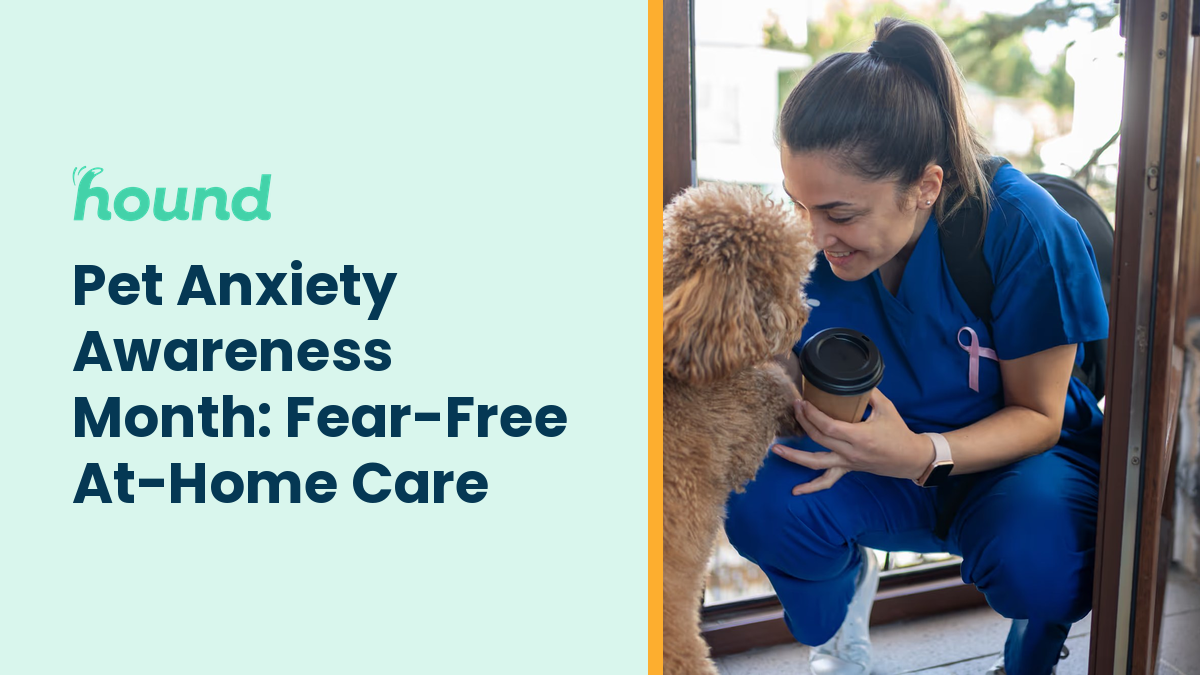
- Meet the highest-FAS patients where they live. For pets whose anxiety peaks at the clinic door, routine care doesn't have to happen at the clinic. Blood draws, vaccines, and rechecks done at home, in the environment where that 91% statistic drops away, keep anxious patients current on care their owners might otherwise defer.
The bigger shift
As Levine put it, a decade of PAAW has helped pet parents understand that anxiety is a medical condition and their veterinarian is an essential partner in managing it. For practices, that's an invitation: the clinics that treat FAS as a care-design problem, not just a patient quirk, will keep more anxious pets in care and more grateful clients attached to their practice.
At-home care pets love
For your highest-stress patients, the kindest exam room is their living room. Homelove sends trained vet techs into homes for blood draws, vaccines, and more, extending your practice's care to the pets who struggle most to reach it.
Sources: Pet anxiety awareness month enters its 10th year with expanded programming, dvm360 Staff, dvm360, June 3, 2026; How common is fear and anxiety in dogs? A study of 43,000 pets offers answers, Chris Mazzolini, dvm360, May 15, 2026.